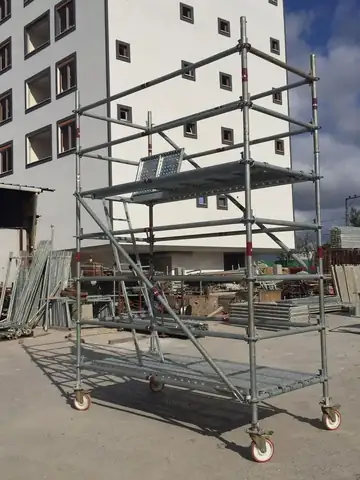
Where is mobile scaffolding used? A wheeled tower scaffold is used to finish indoor and confined-space work in place. For painting, plaster, ceilings, mechanical and electrical services and plant maintenance it offers a locked platform instead of a ladder. On shopping-mall, hotel, hospital, office and warehouse ceiling work, pushing the tower from point to point is faster than stripping and rebuilding every time.
External thermal cladding or high-rise facade work is not solved with mobile scaffolding. The decision becomes clear under three headings: working height, the ground, and how often the job changes location. If the ceiling is 4–8 metres, the floor is level and the work is spread across several points, a mobile tower is the right choice. If there is a facade, wind, anchorage or a heavy pallet, switch to an H-type or ring-lock system.
What is mobile scaffolding, and how does it differ from facade scaffolding?
Mobile scaffolding is a prefabricated access tower built with wheels, vertical frames, a platform, guardrails and, on most models, outriggers. The aim is not to wrap a fixed facade, but to give safe access to several points in the same day. Work must not start until the wheels are locked. The tower is not moved with people on it.
Facade scaffolding is an anchored, storey-by-storey system that stays in place until the job is finished. Ring-lock industrial scaffolding changes shape for vessels, stacks and complex geometry. A mobile tower does not replace either family. Used in the wrong place, both tempo and safety break down.
Prefabricated mobile towers fall under TS EN 1004. The user manual is read with TS EN 1298. Platform and guardrail discipline should not be thought of independently of TS EN 12811. The “small job, an undocumented tower will do” approach is one of the most common reasons for a fall accident.
Where is mobile scaffolding used?
The field of use cannot be stretched to “every height job”. The trades below are the real territory of a mobile tower. The common ground is an indoor or wind-sheltered space, a level floor and a need to relocate often.
Indoor painting, plaster and ceiling work
Wall painting, suspended ceilings, cornices, plasterboard and ceiling plaster are the items where mobile scaffolding is used most densely. A ladder does not allow both material carrying and both hands free. A locked platform keeps roller and trowel work at a safe height.
On housing and offices with a standard storey height, a compact tower is enough. In foyers, atriums and station halls over 6 metres, tower class, outriggers and platform load must be chosen from the start. Extending into the ceiling void by “adding one more lift” is not done without increasing base width.
Mechanical, electrical and plant maintenance
Fire mains, sprinklers, cable tray, lighting fittings, VRF and ducted air-conditioning work all run under the ceiling. On these jobs the crew relocates every 3–5 metres. Erecting a fixed scaffold is both slow and blocks the corridor. A mobile tower finishes the valve or the fitting and moves to the next point.
In plant rooms with isolation, hot lines and rotating equipment, tower placement must not block the escape route. On oily or wet floors, no one goes up without sole plates and wheel locks. Lowering the guardrail because “maintenance is short” does not legitimise an accident.
Shopping-mall, hotel, hospital and office refurbishment
On a shopping-mall shopfront, a hotel corridor, a hospital clinic ceiling and an open-plan office refurbishment, pedestrian and guest traffic continues. When mobile scaffolding is erected on the night shift and reduced in the morning, the business keeps running. Compact models that pass through a narrow lift and a service door are decisive here.
The floor is often ceramic, epoxy or carpet. Hard wheels, floor protection and load distribution must be discussed on the survey. In hospitals and food areas, dust, noise and hygiene rules also affect tower choice. A rusty, undocumented tower with missing guardrails must not be brought onto these sites.
Warehouse, hangar and industrial maintenance
High-bay lighting, sprinklers, flue connections and under-roof insulation are repeating jobs in warehouses and hangars. If there is forklift traffic, the tower working area must be marked, wheels locked and the area below cleared. A narrow tower is chosen between high racks; outriggers are opened in the mid-span of an open hangar.
On this site, mobile scaffolding is not a rival to a ring-lock system. Crane rails, steelwork and the area around a vessel are ring-lock work. A mobile tower only comes in if access is short, the load is light and the floor is level. On mixed geometry, “I’ll just extend the tower I have” does not hold.
Complementary work inside a construction site
Even on a site where facade scaffolding is already up, inner courtyards, stair halls, the inside of lift shafts and under-ceiling work remain. Pushing the facade system into those points inflates the quantity. One or a few mobile towers keep the internal finishing crew working without breaking the facade rhythm.
A shell-and-core floor is often not level. Rubble, rebar ends and wet screed lock the wheels or tilt the tower. On a construction site, mobile scaffolding must only be used on cleaned, hardened ground whose slope has been checked.
Where is mobile scaffolding not used?
External thermal cladding, natural stone, composite cladding and high-rise painting are not mobile-tower jobs. There is no wind, anchorage or pedestrian protection. A tower tried “for one day” on a low villa becomes a platform that walks in the wind.
Heavy pallets, pipe, refractory and formwork loads exceed the platform class of a mobile tower. Around vessels, stacks, pipe racks and silos you need ring-lock industrial scaffolding. Sloping ramps, stair landings and soft fill ground are also ruled out; even with wheels locked, the base does not sit.
In short: do not choose mobile scaffolding for work that does not relocate, is open to the wind, or carries a heavy load.
| Job / site | Mobile scaffolding | Facade or ring-lock scaffolding |
|---|---|---|
| Indoor painting, plaster, ceilings | Suitable | Unnecessary and slow |
| Mechanical, electrical, HVAC maintenance | Suitable | Rarely |
| Shopping-mall, hotel, hospital refurbishment | Suitable | Partial; pedestrian protection separate |
| External thermal cladding / cladding | Not suitable | Primary solution (H-type) |
| Vessels, stacks, heavy industry | Not suitable | Ring-lock system |
Technical criteria that decide the choice
Working height and platform class
The maximum height on the manufacturer’s label is not a “we’ll add one more lift on site” allowance. Indoors the rule does not relax because there is no wind; base width and outriggers limit height. On towers above 10 m, work must not start until outriggers, wall distance and platform load are written down.
Platform class carries two people plus buckets and a tool bag. If plaster bags, a ceramic pallet or service pipe are stacked, the class is exceeded. Overload shows first at the wheel bearing and the frame joint; the accident comes from that point.
Wheels, locks and the ground
A tower with unlocked wheels is not scaffolding; it is a slide. Before work starts all four wheels are locked, outriggers are seated on the ground, and the tower is checked for plumb. On epoxy and ceramic, a non-slip sole; on screed and asphalt, settlement is checked.
Slope, thresholds and cable trenches tilt the tower to one side. The sentence “a bit out of plumb, it’ll do” is not accepted on mobile scaffolding. Height is not increased until the ground is corrected.
Access, lifts and storage
In a shopping mall or hotel the tower must pass through the service lift and door opening. A modular, dismantlable tower is an advantage here. A one-piece tall tower waits on site without ever entering the workplace.
An unused tower is not left in the corridor. An empty tower that falls does as much damage as a working one. Lowering, locking and marking at the end of the shift are part of the work programme.
Safety: do not use the tower like a ladder
Most mobile-scaffolding accidents come from three mistakes. Moving it with people on it. Taking the guardrail off “so I can work comfortably”. Skipping the wheel lock and the outrigger. Those three are the red line of TS EN 1004 on site.
Personal protective equipment does not replace a guardrail. A safety harness is also used on a fully guarded platform; it does not legitimise an unguarded platform. Materials must not be hung from above until the area below is closed.
On low outdoor work that cannot be avoided, a wind stop threshold must be written in advance. Netting and banners create a sail effect on a mobile tower. Leaning the tower against the wall in the wind is not a solution.
Hire or purchase?
On short refurbishment, a single shop and a few nights of hotel work, hire takes away storage, maintenance and haulage. If the facility’s own maintenance crew does ceiling work every week, purchase stops the hire line. For a painting and plastering contractor, a tower standing in the yard is a piece of plant; hire is only a peak-season top-up.
Price runs on quantity and height. A standard tower and a platform above 10 m are not the same item. Haulage, lift constraints and how many days it will stay on site change the quote. A round “send one tower” order produces either insufficient height or excess hire.
| Scenario | Preference | Why |
|---|---|---|
| Day–week refurbishment, single site | Hire | No storage or maintenance |
| Plant maintenance crew, continuous work | Purchase | Hire accumulates |
| Peak season + quiet period | Purchase + hire top-up | Stock flexes |
| Shopping mall / hotel night shift | Hire | Leaves site when the job ends |
Delivery and stock: İzmir, İstanbul, Kosova
Indoor work does not like waiting. A shop handover date, hotel occupancy and a hospital shutdown do not leave the tower as a “we’ll look tomorrow” item. 3B İskele locks survey and quote from the İzmir Torbalı head office; the İstanbul Tuzla factory and Orhanlı warehouse stock speed Marmara shipments.
The Balkan and Kosova (Ferizaj) warehouse line carries the same tower language into the region for hotel–mall refurbishment and plant maintenance. The right tower, the right height and a spare wheel/platform allowance come from ceiling height and door measure, not from a guess on the phone.
Before you go to site, lock these down: clear ceiling, door and lift openings, floor type, how many points, how many shifts, whether guardrails and outriggers are fitted. Without that list, hired mobile scaffolding falls into the “it arrived but it didn’t fit” file.
Common mistakes
Putting a mobile tower onto facade work. Pushing the tower while people are working on it. Raising height after folding the outriggers in a narrow corridor and forgetting to open them. Using the platform as a materials store. Putting an undocumented, mixed-stock tower into a hospital or shopping mall.
The cost of these mistakes is not a small labour loss. A fallen tower, a fallen worker and a closed shop are more expensive than the job itself. Because mobile scaffolding is “light equipment”, discipline is relaxed. Yet the error of light equipment is still subject to the same gravity.
Conclusion
Mobile scaffolding is the right choice for indoor painting, plaster, ceilings, mechanical and electrical services, shopping-mall–hotel–hospital refurbishment and warehouse maintenance. A wheeled tower speeds work that relocates. On facade, wind and heavy industrial work it gives way to an H-type or ring-lock system.
Height, ground, wheel locks, outriggers and the TS EN 1004 document must be read together. Do not close the quantity with “one tower will do”. Send ceiling and access measures; tie the hire or purchase model to the work programme.
For mobile scaffolding suited to your project, request a quote via 3biskele.com or WhatsApp. The İzmir Head Office, İstanbul Tuzla / Orhanlı factory–warehouse and Kosova (Ferizaj) warehouse teams reply in the same site language.