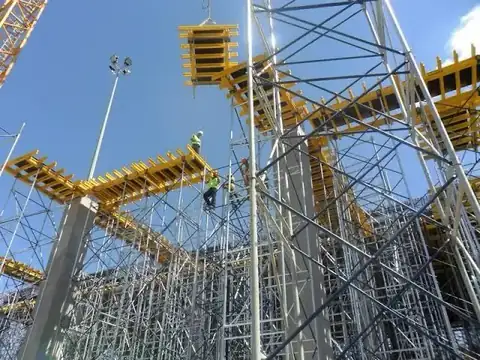
An infrastructure site runs to a different rhythm from a housing facade. On bridges, viaducts, underpasses, culverts, retaining walls and civil structures, scaffolding does not only raise people; it also carries fresh concrete. That is why scaffolding and formwork on infrastructure cannot be discussed as separate topics. Wrong prop spacing, missing braces or an inadequate table deck is a heavy, hard-to-reverse error during a pour.
On highway, railway and municipal infrastructure tenders, time and penalty clauses are hard. You cannot move to the next span until formwork is struck. When you cannot move, crane, pump, steel and crew wait. On infrastructure the scaffolding–formwork decision is the backbone of the programme.
A safe pour comes with three conditions: the right form face, adequate vertical support, controlled striking. If those three are not present at the same time, however fast the rebar is tied, the structure takes a risk. The site manager should keep this trio in mind.
Where do scaffolding and formwork come in on infrastructure projects?
Typical jobs are these: viaduct piers and decks, bridge edge beams and parapets, culverts and box culverts, underpass soffits, retaining walls and walls, water and civil structures, station platforms and pedestrian overpasses.
On this work two needs interlock. The first is access: a working platform for tall piers, edge beams, joints and waterproofing. The second is support: the load-bearing system under slab and deck formwork. For access, ringlock or H-frame towers come to the front; for support, table forms, cuplock towers and telescopic props.
When is table form scaffolding the right solution?
Table form systems gain speed on repeating slab and deck spans. The table is erected once, the pour is taken, and after adequate strength the table is rolled or crane-lifted to the next span. Especially on viaducts and multi-span bridges, this repetition visibly shortens labour time.
The table’s advantage is not only speed. A regular grid lets load descend more cleanly into the vertical members. It is easier to inspect than a scattered forest of props. But a table is not a magic wand for every geometry. Inclined piers, varying sections, tight culvert interiors or a highly broken form face may need towers and special formwork instead of tables.
Moving the table is a work item in its own right. If crane capacity, road traffic, night working and deck stiffness are not planned, saying “let’s shove the table” damages both equipment and the form face.
Telescopic props and classic falsework
On smaller spans, stair landings, culvert soffits and slabs at varying levels, telescopic props remain indispensable. Jacks allow them to adapt to different heights. Used correctly they are economical. Used wrongly they are the most frequent source of accidents and deflection.
The classic mistakes are known. Opening prop spacing too wide. Leaving out head and base plates. Leaving props out of plumb. Choosing inadequate primary and secondary beams above. Tightening props at random during the pour with “we’ll nip them a bit more”. Fresh concrete forgives none of these mistakes.
When a prop forest is erected, walking space and escape gaps must not be forgotten. Tight prop spacing both makes inspection harder and spoils the rebar crew’s movement. On infrastructure, falsework is not a storage area.
Where do cuplock and ringlock towers sit on infrastructure?
On tall piers, wide spans and heavy deck loads, cuplock or ringlock towers produce a stiffer grid than telescopic props. Nodes, diagonals and standard lift heights make the calculation readable. The same family is also used for scaffolding around viaduct piers, tall retaining walls and the external faces of civil structures.
Here the choice must follow load and geometry, not stock habit. The sentence “we have props in hand” is not sufficient justification on an 80 cm deck and a high span. The calculation must see vertical load, wind, seismic zone and pouring sequence together.
Ringlock has the advantage on asymmetric platforms around piers and on inclined geometry. Cuplock gives speed on regular grids and falsework towers. On many large infrastructure jobs the two systems work as siblings on the same site.
Concrete pour: the scaffolding’s exam moment
The real test of a falsework system is the moment the pump and vibrator work. Load jumps, horizontal forces appear, deflection is watched. At that moment the site must have a responsible person, communication and a stop authority. The approach “we’ll pour a bit more, then we’ll look” leaves a mark on walls and decks.
Pouring sequence is also part of the scaffolding plan. From edges to the middle, from mid-span to supports, or the sequence written in the project — it must not be changed at random. Sudden stacking overloads props in one zone before the others.
Striking time must be tied to concrete strength. Early striking looks as if it saves the programme; it leaves deflection and cracks in the structure. Late striking locks the next span. The decision must follow cube/cylinder results and the designer’s note. On infrastructure there is no rule that “it is always struck in three days”.
Traffic, ground and site constraints
Bridge and viaduct work often runs beside live traffic. Clearance under the structure, lane narrowing, night pours and pedestrian safety affect scaffold legs. A leg that spills into a lane means both an accident and an administrative penalty. Layout must be drawn together with traffic engineering.
Ground on infrastructure is deceptive. Fill, work not yet compacted, slopes softened by rain and river beds cause base plates to sink. On tall towers, ground improvement, sole plates, concrete pads or steel spreaders may be required. However solid the structure above, one settling leg bends the entire grid.
Rivers, valleys and sloping ground change vertical member lengths. If the two sides of the same span are at different levels, a “standard tower” is not enough. Locking quantities without survey photographs and levels is the classic infrastructure surprise.
Column, wall and edge-beam formwork
While scaffolding is discussed, the form face must not be forgotten. Trio and similar modular wall forms give repetition speed on piers and walls. Column forms set the geometry of the vertical member and the quality of the concrete surface. Edge beams and parapet cantilevers are details that want both formwork and scaffolding.
Surface quality, especially on visible bridge edges, affects client acceptance. Form leaks, marks and panel steps come back later as repairs. Good scaffolding does not save bad formwork. Good formwork also deflects with inadequate support. They are the same package.
Hire economics and hidden losses
For the infrastructure contractor the most expensive item is the formwork–scaffolding set that looks as if it is not waiting on site. In fact every waiting day is crane, pump, penalty and cash flow. That is why the quote must be read not only for daily hire but for delivery time, spare tables, lost-part procedure and the dismantling crew.
Part loss is high on infrastructure. Props, heads, walers and pins disappear in the mud. Labelled handover, palletised stock and a dismantling count cut that loss. The sentence “we’ll count later” is a surprise invoice at the end of the project.
Purchase can make sense for firms that take similar culvert and bridge jobs every year. On a single large viaduct, hire reduces the burden on the balance sheet and on storage. 3B İskele discusses this distinction with the programme, not with sales pressure. Because on infrastructure the right model is not pride in stock; it is handing over the span on time.
Common mistakes
Opening prop spacing by habit. Promising table moves without a crane plan. Forgetting anchors and clearance under live traffic. Striking formwork early. Going to pour without checking the ground after rain. Mixing access scaffolding with the falsework system.
The shared root of these mistakes is haste and intuition. Infrastructure concrete does not forgive. Because it does not forgive, calculation, survey and site inspection are not “extras”; they are the job itself.
How is the right solution locked?
On the survey, span, height, ground, traffic and pouring method must be seen. Then the system family is chosen: tables, towers, props, wall formwork, access scaffolding. Then the structural note and erection–striking sequence are written. Finally the hire period is tied to the number of spans in the programme.
A quote that skips this sequence looks cheap and explodes on site. A supplier that holds the sequence lets the site manager breathe. Because 3B İskele keeps table forms, telescopic props, column–wall formwork and industrial towers under the same roof, it does not fragment infrastructure work. When you say “we need formwork”, you have actually said “let this deck be poured without deflection, and let us move to the next span on time”.
Three measures should be remembered again: face, support, striking. If these three are held on site, the bridge moves.
Conclusion
On infrastructure, bridge and viaduct projects, scaffolding and formwork are two faces of one decision. Table systems give speed on repeating spans. Telescopic props are economical on small and varying levels. Cuplock and ringlock towers provide stiffness on high loads and around piers. Traffic, ground and pouring sequence cannot sit outside this choice.
On the next civil structure, do not settle for a round quantity. Ask for a survey, calculations and staged delivery. Falsework laid out with 3B İskele is infrastructure’s quietest but most critical success: the concrete was poured, there is no deflection, the span was handed over.